Saturday, 16 June 2018

1918-11-11 Spectator War End News Part 2


The Hamilton Spectator had first announced the news in Hamilton that the Great War which started four years previously was over.  A bulletin to that effect had been posted in a first floor window of the Spectator during the noon hour of November 7, 1918.

The news had set off a wild celebration that grew and grew as the hours. The Spectator rushed out an extra edition of the paper with the banner headline, ‘It Is Finished!’


That same headline continued to appear in the last edition of the paper for that day, although within the paper itself the following short article was printed, under the headline, ‘An Explanation,’

 “In connection with the breaking of the news to the world that the armistice had been signed by the Germans, it should be stated that this information came to the people of this country through the medium of the United Press, and carried with the signature of its president, Roy W. Howard, regarded as one of the cleverest and most reliable newspapermen in the profession.

“The United Press has on many former occasion scooped its rival, the associated Press, in the breaking of big news items, and in this instance, it is significant that at 3 o’clock this afternoon, the Associated Press was throwing doubt upon the statement sent out by Mr. Howard that an armistice had been signed.

“The latest news that the Spectator has on the subject comes from Brest, France, which relates that the populace of that city is celebrating the news of the signing of the armistice with great abandon.”1

1 “An Explanation”

Hamilton Spectator.    November 07, 1918.

The Hamilton Herald was quick to point out the Spectator’s mistake, and in a late edition called the Spectator’s “breaking’ of the big news a hoax.

The next day, the following was published, with the Spectator that it was ‘exclusive to the Spectator,’ although it may well have been ‘exclusive’ to every newspaper that relied on the United Press for its international news:

 “Exclusive to the Spectator

Brest, France, Nov. 8. – Rear Admiral Henry B. Wilson, U.S.N., commander of the American forces in French waters, today made the following statement :

‘The statement of the United Press relative to the signing of the armistice was made public from my office on the basis of what appeared to be official and authoritative information.

‘I am in a position to know that the United Press and its representatives acted in perfectly good faith, and that the premature announcement was the result of an error, for which the agency was in nowise responsible.’2

2 “Origin of Story”

Hamilton Spectator.    November 08, 1918.

The Spectator was also fully prepared to punch back at the Herald for its ‘hoax’ aspersion:

 “Perhaps no newspaper published in Canada exemplifies more inefficiency, inaccuracy, ingratitude and effrontery than the Hamilton Herald. If you don’t think so, get the Herald to explain why it doesn’t publish its circulation figures.

“Here is an instance of its ability in the line of downright cheek and impudence : Yesterday the Herald carried a front page story holding up to ridicule this Great Family Journal for publishing the United Press story of the signing of the armistice terms.

“In very large type, a heading referred to us as follows :

‘Spectator Scoop Proved to Be Hoax’

“Just to show our thousands of readers who never see that scurrilous sheet, just what the Herald carried about that same story, the Spectator publishes herewith a photo reproduction of the Herald of November 7 and the headlines it carried to announce the same story as the Spectator. What do you think of this?”3


3 As to Hoaxing”

Hamilton Spectator. November 8, 1918

 Finally, during the predawn hours of November11, 1918, the news, the confirmed news, that an armistice had been signed formally bring a cessation of hostilities, reached Hamilton.

Although wild celebrations broke out, but some readers of the Spectator’s rival daily, the Hamilton Herald were unkind enough to ask if the story was real this time, or just another Spectator hoax?

The Spectator had an extra edition prepared and it hit the streets, carrying the headline, ‘Armistice Signed’ long before the Herald’s managed to get an extra edition sent out. Still sensitive about the situation of November 7, the Spectator carried a lengthy boast to how it was the first to announce the news of November 11, and to get an extra edition out of the streets that morning:

 “It was left to the Spectator to give the first information to the people of this city of the signing of the armistice and the announcement of the cessation of hostilities.

“In Washington, at 2:45 this morning, this information was given to representatives of all the news agencies of the continent, and in turn was immediately flashed by their representatives to their clients all over the country.

“The Spectator has a direct United Press leased wire to Washington, and the flash was received here at 2:45, eleven minutes before the arrival of the same news over the Canadian Press wire.

“Preparations had been made to distribute an early morning extra, and this was on the street at five minutes after five o’clock, and contained  nearly thirty columns of the most important war news since the war broke out four years ago.

“In spite of the early hour, there were thousands waiting to receive the Spectator extra, and the demand was unprecedented in this history of this newspaper.

“The Spectator was on the street thirty minutes before any of its local competitors, and a comparison of the extras tells the tale. We invite criticism.

“The three Toronto morning papers that serve Hamilton did not carry a single line of the news of the signing of the armistice.

“Another best for the Spectator. Rely on this Great Family Journal and you will be served with the latest and most complete news.”

4 “Spec Scores Again”

Hamilton Spectator.    November 11, 1918

Even in the midst of the raucous, noisy celebrations of the confirmed signing of the armistice, the Spectator printers could not resist making a visit up King street west and make a stop in front of the Herald office :

          “Humorous – from one point of view only – was the serenade of the Herald office by the Spectator printers and the posting of a bulletin on the Herald window that the Spectator had beaten the competitors ten minutes on the ‘flash.’

“ ‘Sharpen your scissors and wait for the Spec to come out!’ they shouted, flags waving in the breeze and a discordant flute band struggled with the Dead March. It was ample revenge for the scurrilous attack in the King street sheet on Friday – and how the printers did enjoy themselves!”5

5“All Hamilton Joins in Wild Celebration : High Carnival Reigned When Momentous Flash Circulated – City Rocked With Frantic Joy : Whistles Shrieked, Bells Clanged, Thousands Paraded Streets in Lid-Lifting Celebration”

Hamilton Spectator.    November 11, 1918.


Thursday, 14 June 2018

1918-11-09 HumanFly


“Barney Bergen, business manager for Harry H. Gardiner, the Human Fly, arrived in the city this morning and is busy today completing arrangements for Mr. Gardiner to climb the bank of Hamilton building at 12:30 o’clock Monday afternoon next.”1

1 Hamilton Herald.    November 09, 1918.

The strategy of the leaders of the Victory Loan campaign, in getting as many Hamiltonians as possible to subscribe, was to gather as many people as possible in one place. When that happened, Victory Loan could meet and hopefully convince as many citizens as possible to loan money to the federal government, with the commitment of the government to later repay those moneys with a handsome return.

To that end, it was decided to bring to Hamilton, Mr. Harry Gardiner, better known internationally as The Human Fly. Two days in advance of the Human Fly’s arrival in Hamilton, his manager arrived and made the rounds of the local newspaper offices for promotion purposes.

The Hamilton Herald carried the following account of the meeting with the Human Fly’s manager :

“In conversation with a Herald reporter, Mr. Bergen said Mr. Gardiner, during the past thirteen years, had successfully climbed seven hundred high buildings, throughout Europe and the United States. He commenced his ‘Human Fly’ act thirteen years by climbing the Flat Iron building in New York. With one exception, he has never had an accident. This was while climbing a building in the southern States, when he had a fall which laid him up for a few years.”1

1 “The Human Fly”

Hamilton Herald.    November 09, 1918.

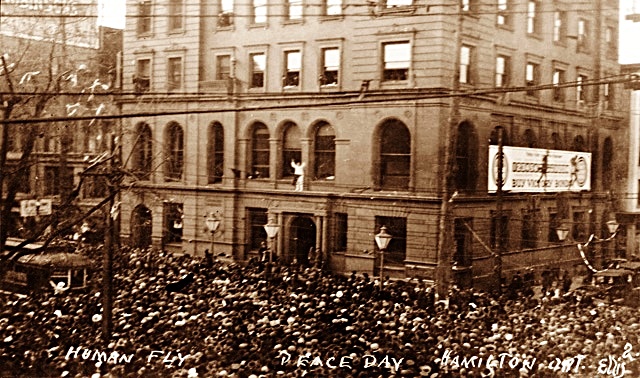
The appearance of the Human Fly at the site of the Bank of Hamilton, King and James streets, had already been firmly scheduled for 12:30 p.m., November 11, 1918, before it was known that the date selected would be the one when it was confirmed that an armistice to end the Great War had been signed.

Wild celebrations had been underway since way before dawn on Monday, November 11, 1918. Also Hamilton Mayor Booker had declared the day to be a public holiday. For the Victory Loan people, it was a stroke of good fortune as the number of people capable of being present to witness the stunt of climbing the Bank of Hamilton building.

The Spectator published on November 12, 1918, carried the following vivid account of how the Human Fly carried off his stunt :

 “The most sensational stunt in connection with the Victory loan campaign, and one of the most nerve-wracking free exhibitions ever given in this city, was given by Harry Gardiner, the American Human Fly, at noon yesterday, on the walls of the Bank of Hamilton, in the presence of thousands of spectators. Mr. Gardiner climbed the wall from bottom to top, and when he reached the cornice, he swung out from the building supported by one hand only. He finally pulled himself on to the roof and disappeared from view. His daring act was freely applauded by thousands, although many held their breath at times. One woman in the gathering fainted and required medical attention.

“On his way up the wall, Gardiner addressed the crowd on Victory bonds, urging his hearers to do their utmost for the boys who fought for the world’s freedom. Bond salesmen passed through the crowd, and not a few persons subscribed.

“In an interview, Gardiner stated that his performance was not all due to strength in his hands and arms. ‘It is 60 % physical, and 40% mental,’ said the Human Fly, who has scaled the walls of over 400 of the highest buildings in the United States. The only fall he ever had was from the state capitol building of Carolina when, on a slippery day, he fell 51 feet, sustaining broken ribs and a smashed nose from which he carries the scar yet. Two months later, he made the climb where he fell.

“Gardiner’s home is in Washington. He left the city in the afternoon.”2

2 “Held Their Breath : While Human Fly Climbed the Bank of Hamilton Walls”

Hamilton Spectator.    November 12, 1918.


Thursday, 7 June 2018

1918-11-07 Spectator War End News Part 1


 “Hamilton learned through the Spectator that the war was over.

At twenty-five minutes past the noon hour, there appeared in the Spectator window a bulletin paper bearing the hasty scrawl :

‘The war is over – Hostilities cease at 2 o’clock today – Official’ ”

Hamilton Spectator. November 7, 1918.

The first floor windows facing the James street south side of the Hamilton Spectator were always the focus of interest  for people as they passed by. Bulletins received by telegraph, if considered to be of immediate interest would be pasted in that location.

During the lunch hour of November 7, 1918, a different kind of bulletin was pasted in the Spectator window, and the news being bulletined was extremely welcome:

“The greatest and most glorious news that Hamilton ever heard hit the city like a thunderbolt. The usual knot of bulletin readers perusing the morning war dispatches rubbed their eyes. They believed not for joy.

“Then a young girl gasped : ‘O-o-o-h! The war’s over!’ Somebody started to cheer, but the majority took flight to the nearest telephone to spread the joyful news.

“The glad intelligence spread like wildfire. Five minutes after the bulletin appeared in the window it was in everybody’s mouth in the streets. So the great war was over; the allies had won; the Hun vanquished at last. Glory Hallelujah!

“But it was not till about 1 o’clock that news had thoroughly filled the city. Then Hamilton abandoned itself in a delirium of joy. The celebration was of necessity of a spasmodic character. Sirens screamed, bells clanged, klaxons tooted, cheers resounded through the city streets.

“The telephone system was unprepared for the shock, and was disorganized automatically. Thousands and thousands of calls were put into central and central collapsed. By 1:15, there was not a chance of getting a number.

“Organization is being completed for a grand thanksgiving celebration to be held later.”1

1 “Spec Broke ‘News’ ”

Hamilton Spectator.    November 11, 1918.

The Spectator immediately assigned staff to cover the celebrations touched off by the news that the war was over.

The next day’s Spectator contained the following description of what happened:

“Did Hamilton celebrate that report?

“Yes, verily, she did – with a roar and a whoop that surely must have soared right past our own boys in France and Flanders and rattled the windows at Potsdam. The old town just turned itself inside out in frantic, spontaneous joy. The lid was torn right off’n the city. No official holiday proclamation was necessary. Everybody, big and little, young and old, just hiked for uptown districts and added their full share to the raw and raucous bedlam of noise that shook the city from end to end.

“Hamilton never had another celebration like it – and won’t equal it again until the boys who are making victory possible come marching home.”2

2 “Bedlam of Noise Shook Old Town From End to End : Peace Report Frantically Received By People : Was Wildest Time Hamilton Ever Experienced : Uptown Streets Choked With Cheering Throngs.”

Hamilton Spectator.  November 8, 1918.

It did not take long after the bulletin had been pasted in the window for things to get very raucous in the downtown core:

“It was just ten minutes after the report that had been signed had been bulletined in the Spectator window that the first parade was in action. Headed by a hatless man, who toted one of the biggest Union Jacks in town, the clerks of one of the uptown stores formed in line. Holding up the folds of the big Union Jack was an old women, who with tears of gladness streaming down her cheeks, fervently pressed the flag to her lips and kissed it time and time again..

“ ‘I bet she has a dear boy overseas,’ remarked a bystander.”2

Indeed, the reaction of the old woman would not be the only tearful one :

“There were hundreds like her, whose emotion had its outlet in tears. Not all of them had boys coming back, either. Many there were who, though thanking God that the titanic struggle of right against might was reported over, thought also of their own dear sweet men – sons, brothers, husbands, sweethearts – who sleep in Flanders fields where poppies blow – those heroes who so freely gave their todays that we might have our tomorrows. In hundreds of home yesterday afternoon and forbade an active part in the uptown celebration. The scars from the searing hand of the war god, Mars, were appallingly numerous.” 2

Those involved in the downtown scenes of jubilation put aside any feelings of sadness over those lost in the war for the moment. The news that the guns of war were silenced was all that they wanted to consider, and they wanted to parade:

“That first little parade took on numbers with every step. The postmen, armed with flags, fell in line. Every automobile was decked with flags and streamers and freighted down with noisy, frenzied humans, horns, tin pans, kettle covers that were pressed into service as cymbals. Tubs that were utilized as drums and – well, if you weren’t in it, you were strictly out of it.

“Where all the flags and noise-making instruments came from on such short notice will always be a mystery. One didn’t think there were so many flags in the world as were on display an hour after the celebration started. First of the local bands to put in an appearance was the crack musical organization of the 91st Highlanders, which, at 3 o’clock, rendered patriotic airs at the Gore, while thousands, quivering and shaking with excitement, cheered and sang themselves into hoarseness.”2

(To Be Continued)


Wednesday, 16 May 2018

1918-11-07dd


It was news that had been longed for since the summer of 1914. After four bitter, nightmarish years of warfare, it was announced that the world-wide conflict was over.
A large number of Hamiltonians felt that November 7, 1918 would long be remembered as the day that peace had be declared. Mass celebrations broke out spontaneously all over the city.
The Herald reported its afternoon edition the following :
“The news that Germany had surrendered and that peace had come caused a tremendous sensation in the city about noon today. The report seemed like an electric spark that touched the entire city.
“Within a few minutes after the first unofficial word came, the Herald office telephones began to ring as though every person in the city had heard the glad tidings. Never on any occasion did new spread so fast, and never were so many enquiries made in so brief a time
“As soon as the announcement was bulletined in the Herald windows, auto horns began to toot and everything that would make a noise was put into operation.
“An incident in the Herald office about 1 o’clock, typified the general feeling.
“An excited lady entered the editorial room.
“‘Is it true the war is over?’ she asked.
“She was informed that there was a rumor to that effect.
“ ‘Thank God!’ she exclaimed. ‘I have a son over there. Oh, it’s good to know that I shall see them again. I’ve prayed for nine months that this war would end, and that God would spare him. Thank God.’ ”1
1 “How Hamilton Cut Loose : Big Celebration When Rumored End of the War Was Announced.”
Hamilton Herald.   November 7, 1918.
Shortly after 1:30 p.m., the Herald issued a special edition of the paper repeating the end of war rumor. An impromptu procession was formed. Headed by a band playing stirring patriotic airs, the parade proceeded through the downtown streets.
The operators of the Bell Telephone Company were overwhelmed, so much so that a manger with the company sought out the Herald to make an explanation to the phone company’s subscribers :
“He stated that shortly after the first report of peace, the office was inundated with calls, and never in the history of the local office were the operators so rushed.
“ ‘We simply could not answer all calls,’ he said. ‘I never knew anything like it. This explanation is due our subscribers, and we think they will understand the situation and excuse what might have seemed poor service.’”1
That special afternoon of the Herald contained the following editorial:
“Shortly after noon today, a ‘flash’ came that the terms of the armistice had been accepted by the German military commission, that the armistice had been signed, and that hostilities would cease at 2 p.m.
“This report has not been officially confirmed up to the time of writing – 1:30 p.m. It may not be true; but if not true, we believe it is only anticipatory of the truth. Germany is not in a condition to prolong resistance. If peace has not already come, it is near.”2
2 “Peace?”
Hamilton Herald.  November 7, 1918.
The next day, the Herald contained the following description of the celebrations that the “news’ of peace had provoked:
“Hamilton has had some great  celebrations in the past, but never was there an outburst such as that of yesterday, when it was falsely reported that an armistice had been signed with Germany. The news, like fire in the heather, spread over the city almost instantly, and great crowds assembled in the center of the city and let loose the feelings that had been suppressed during four years of war and all its horrors.
“All Hamilton joined in one shout of joy. Indeed, the huge crowd seemed almost delirious. Statements that the news was not confirmed, as published by the Herald, were disregarded. The people would not believe them. Huge as were the crowds in the afternoon, they were small compared with those on the streets at night, and the din they made would ‘deave the miller.’
“Parades were formed in all places and made for the central streets, which were carpeted with paper and confetti, all mashed to a paste in the muck that was caused by the light rain.
“Conspicuous in the parade was a float representing the Spectator. That paper announced in the afternoon that the news was official, and the United Press Service, which furnished the false information to it, boasted of its great ‘scoop’ over its rival, the reliable Associated Press.” 3
3  Spectator ‘Scoop’ Proved to Be Hoax : Its Boastful Announcement That It Was Officially Reported That Armistice Had Been Signed Turned Out to Be False : A.P. Service To Be Relied On : Herald Published Official Denials of Report, and In Its Windows Bulletined All the Real News After Press Time.”
Hamilton Herald.  November 8, 1918.
The Herald maintained that it had not claimed that the war was over:
“”The Associated Press dispatches, published in the Herald, announced definitely that the armistice had not been signed, but people were so delirious with joy that they had no thought of reading carefully what was published in these dispatches and bulletined in the Herald office windows till ate in the evening.
“Then some began to reflect, and realized that the United Press’ great ‘scoop’ was a cruel hoax, and they did not hesitate to say it. Many went disappointed away from the Herald office to their homes.”3
While the Herald did acknowledge that the Spectator’s source of the ‘scoop’ was an inaccurate dispatch originating in the office of the United Press service, it was less forgiving about subsequent actions taken by the Spectator:
“The Spectator’s float in the procession, in spite of the denials by the Associated Press, continued to spread the false report all night. A large painted streamer on either side of it read : ‘Peace News Was Spectator Scoop.’
“As the evening wore on, hundreds of people, both through the Herald office telephones and its bulletins, were made aware of the facts, and the greatest jubilation ever known here pretty well died out by 11 o’clock.”3
Although the celebrations that had occurred throughout the afternoon and evening had been initiated by faulty information, they were nonetheless very memorable:
“When the bells and whistles throughout the city joined in the peace announcement, a foreigner who was engaged in some excavating work at the Steel Company of Canada works, thinking that the big noise was part of the Victory Loan campaign, turned to some fellow workmen, remarking : ‘That’s all right, I buy Victory bond. Me no stop work.’ A few minutes later it was announced that the bells and whistles were announcing the conclusion of the war. The foreigner immediately threw down his shovel, tossed his cap high in the air, and with a cry of joy rushed away in the direction of his home, shouting ‘the war is over,’ and up to this morning had not returned to his job.
“To add to the pleasure of many merry makers, yesterday afternoon, Tasker’s contributed about eight dozen hats, of the 1780 vintage, to the large numbers who had gathered in front of the Herald office and his store, located directly opposite. The donation caused many laughs and much pleasure to the pleasure-hungry crowds.
“A couple of returned soldiers complained to the proprietor of a North James street fruit store because he continued to keep his place of business open, while the big jubilee was in progress yesterday afternoon. An argument followed, which resulted in a free-for-all fight and the smashing of the fruit store window.
Hamilton’s hive of industry, which has been preparing munitions of war, as well as all her other busy places, poured their thousands forth on the streets yesterday afternoon, when the unofficial announcement  of the truce was announced and swarmed all afternoon along the public places, giving full vent to the emotion they had suppressed all through the war.
“Employees from all the large companies turned out in force, and bearing flags, tin horns and confetti immediately proceeded to the center of the city. One parade met another until King and James streets presented a scene unprecedented in the city’s history. Passing automobiles were speedily loaded down with young lads, all returned soldiers who were enjoying the news were invited to ride, and from noon until eve the crowds passed and repassed with a never slackening in the enthusiasm, even when later bulletins did not vouch for the truth of the armistice. ”3
The corner of King and James streets was a focus for the celebrations, and the Herald office was on King street, only a short distance west of the James street intersection:
“That nothing should be missing in the celebration, the band of the 91st Highlanders, headed by Lieut. Harry Stares, appeared on the scene and played patriotic music outside the Herald’s windows. The crowd, with the exception of a few foreigners, who evidently did not join in the celebration, uncovered their heads and sang ‘O Canada’ and the ‘Maple Leaf Forever’ followed, which were sung on mass by several thousand people. A returned soldier led the singing of ‘Blighty.’
“The street cars ran spasmodically. The traffic regulation most of the afternoon was demoralized. The crowd was orderly, though enthusiastic, and there were no unpleasant occurrences.”3
The afternoon celebrations were spontaneous and free-flowing, but by the time evening had arrived things were more organized:
“The notice that a parade would be held, starting from the Market Square at 7 o’clock, had all Hamilton moving in that direction before that hour. The central streets were filled from curb to curb with traffic, afoot and awheel, and the night’s doings commenced at once.
“Special traffic officers were appointed by Chief Whatley to direct the movements of the vehicles and the marching crowds, and out of seeming disorder preserved order. They could not, however, keep open the street railway lines in the center of the city.
“There were bands of all kinds, but principally those composed of tin pans beaten with sticks. The bands of the 91st Highlanders and the 13th Royal regiment turned out. The 91st band mounted a stand in Gore park, and played patriotic airs under the direction of H. A. Stares, who also led the community singing in which the thousands there joined with vigor.
“A number of attractively decorated autos were in the great parade, and the streets were ablaze with bright-hued flags of all the allied nations. Fireworks added to the brilliance of the scene, as thousands of rockets and Roman candles flashed into the night.
“The crowd was all good-humored. There was a good deal of pushing and jostling, but it was under the spirit of joy. Some young men thoughtlessly produced ticklers and pushed them into the faces of the crowd, heedless of the danger they ran of spreading influenza among the people. The police were on the alert for these germ carriers and took a number from those who carried them.
“ A German woman of considerable proportions came very near to creating a riot while the big parade was in progress last night. The woman took up a prominent position near the corner of King and Macnab streets, as the parade passed she shook her fists at the occupants of the floats, at the same time calling them ‘dirty English.’ A couple of women who were standing near the Kaiser admirer grabbed her, and before the angry German woman was released from her captors, she was missing several hanks of hair. The last seen of the German woman  she was beating it toward the mountain closely followed by a crowd of boys who were hooting and jeering her.”3
Although when Hamiltonians settled down after the afternoon and evening celebrations and realized that the war was, sadly still in progress, there was still a feeling of thankful anticipation that the end was near.