Thursday, 14 June 2018

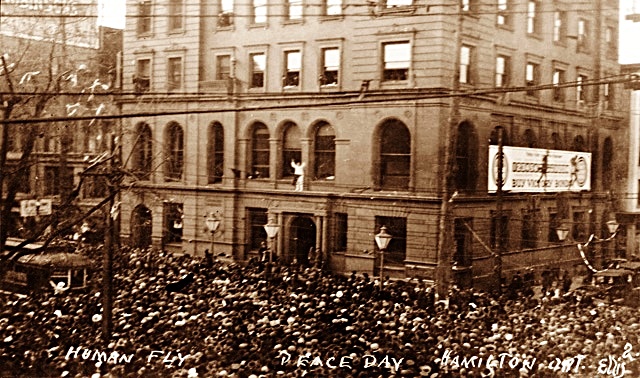
1918-11-09 HumanFly


“Barney Bergen, business manager for Harry H. Gardiner, the Human Fly, arrived in the city this morning and is busy today completing arrangements for Mr. Gardiner to climb the bank of Hamilton building at 12:30 o’clock Monday afternoon next.”1

1 Hamilton Herald.    November 09, 1918.

The strategy of the leaders of the Victory Loan campaign, in getting as many Hamiltonians as possible to subscribe, was to gather as many people as possible in one place. When that happened, Victory Loan could meet and hopefully convince as many citizens as possible to loan money to the federal government, with the commitment of the government to later repay those moneys with a handsome return.

To that end, it was decided to bring to Hamilton, Mr. Harry Gardiner, better known internationally as The Human Fly. Two days in advance of the Human Fly’s arrival in Hamilton, his manager arrived and made the rounds of the local newspaper offices for promotion purposes.

The Hamilton Herald carried the following account of the meeting with the Human Fly’s manager :

“In conversation with a Herald reporter, Mr. Bergen said Mr. Gardiner, during the past thirteen years, had successfully climbed seven hundred high buildings, throughout Europe and the United States. He commenced his ‘Human Fly’ act thirteen years by climbing the Flat Iron building in New York. With one exception, he has never had an accident. This was while climbing a building in the southern States, when he had a fall which laid him up for a few years.”1

1 “The Human Fly”

Hamilton Herald.    November 09, 1918.

The appearance of the Human Fly at the site of the Bank of Hamilton, King and James streets, had already been firmly scheduled for 12:30 p.m., November 11, 1918, before it was known that the date selected would be the one when it was confirmed that an armistice to end the Great War had been signed.

Wild celebrations had been underway since way before dawn on Monday, November 11, 1918. Also Hamilton Mayor Booker had declared the day to be a public holiday. For the Victory Loan people, it was a stroke of good fortune as the number of people capable of being present to witness the stunt of climbing the Bank of Hamilton building.

The Spectator published on November 12, 1918, carried the following vivid account of how the Human Fly carried off his stunt :

 “The most sensational stunt in connection with the Victory loan campaign, and one of the most nerve-wracking free exhibitions ever given in this city, was given by Harry Gardiner, the American Human Fly, at noon yesterday, on the walls of the Bank of Hamilton, in the presence of thousands of spectators. Mr. Gardiner climbed the wall from bottom to top, and when he reached the cornice, he swung out from the building supported by one hand only. He finally pulled himself on to the roof and disappeared from view. His daring act was freely applauded by thousands, although many held their breath at times. One woman in the gathering fainted and required medical attention.

“On his way up the wall, Gardiner addressed the crowd on Victory bonds, urging his hearers to do their utmost for the boys who fought for the world’s freedom. Bond salesmen passed through the crowd, and not a few persons subscribed.

“In an interview, Gardiner stated that his performance was not all due to strength in his hands and arms. ‘It is 60 % physical, and 40% mental,’ said the Human Fly, who has scaled the walls of over 400 of the highest buildings in the United States. The only fall he ever had was from the state capitol building of Carolina when, on a slippery day, he fell 51 feet, sustaining broken ribs and a smashed nose from which he carries the scar yet. Two months later, he made the climb where he fell.

“Gardiner’s home is in Washington. He left the city in the afternoon.”2

2 “Held Their Breath : While Human Fly Climbed the Bank of Hamilton Walls”

Hamilton Spectator.    November 12, 1918.


Thursday, 7 June 2018

1918-11-07 Spectator War End News Part 1


 “Hamilton learned through the Spectator that the war was over.

At twenty-five minutes past the noon hour, there appeared in the Spectator window a bulletin paper bearing the hasty scrawl :

‘The war is over – Hostilities cease at 2 o’clock today – Official’ ”

Hamilton Spectator. November 7, 1918.

The first floor windows facing the James street south side of the Hamilton Spectator were always the focus of interest  for people as they passed by. Bulletins received by telegraph, if considered to be of immediate interest would be pasted in that location.

During the lunch hour of November 7, 1918, a different kind of bulletin was pasted in the Spectator window, and the news being bulletined was extremely welcome:

“The greatest and most glorious news that Hamilton ever heard hit the city like a thunderbolt. The usual knot of bulletin readers perusing the morning war dispatches rubbed their eyes. They believed not for joy.

“Then a young girl gasped : ‘O-o-o-h! The war’s over!’ Somebody started to cheer, but the majority took flight to the nearest telephone to spread the joyful news.

“The glad intelligence spread like wildfire. Five minutes after the bulletin appeared in the window it was in everybody’s mouth in the streets. So the great war was over; the allies had won; the Hun vanquished at last. Glory Hallelujah!

“But it was not till about 1 o’clock that news had thoroughly filled the city. Then Hamilton abandoned itself in a delirium of joy. The celebration was of necessity of a spasmodic character. Sirens screamed, bells clanged, klaxons tooted, cheers resounded through the city streets.

“The telephone system was unprepared for the shock, and was disorganized automatically. Thousands and thousands of calls were put into central and central collapsed. By 1:15, there was not a chance of getting a number.

“Organization is being completed for a grand thanksgiving celebration to be held later.”1

1 “Spec Broke ‘News’ ”

Hamilton Spectator.    November 11, 1918.

The Spectator immediately assigned staff to cover the celebrations touched off by the news that the war was over.

The next day’s Spectator contained the following description of what happened:

“Did Hamilton celebrate that report?

“Yes, verily, she did – with a roar and a whoop that surely must have soared right past our own boys in France and Flanders and rattled the windows at Potsdam. The old town just turned itself inside out in frantic, spontaneous joy. The lid was torn right off’n the city. No official holiday proclamation was necessary. Everybody, big and little, young and old, just hiked for uptown districts and added their full share to the raw and raucous bedlam of noise that shook the city from end to end.

“Hamilton never had another celebration like it – and won’t equal it again until the boys who are making victory possible come marching home.”2

2 “Bedlam of Noise Shook Old Town From End to End : Peace Report Frantically Received By People : Was Wildest Time Hamilton Ever Experienced : Uptown Streets Choked With Cheering Throngs.”

Hamilton Spectator.  November 8, 1918.

It did not take long after the bulletin had been pasted in the window for things to get very raucous in the downtown core:

“It was just ten minutes after the report that had been signed had been bulletined in the Spectator window that the first parade was in action. Headed by a hatless man, who toted one of the biggest Union Jacks in town, the clerks of one of the uptown stores formed in line. Holding up the folds of the big Union Jack was an old women, who with tears of gladness streaming down her cheeks, fervently pressed the flag to her lips and kissed it time and time again..

“ ‘I bet she has a dear boy overseas,’ remarked a bystander.”2

Indeed, the reaction of the old woman would not be the only tearful one :

“There were hundreds like her, whose emotion had its outlet in tears. Not all of them had boys coming back, either. Many there were who, though thanking God that the titanic struggle of right against might was reported over, thought also of their own dear sweet men – sons, brothers, husbands, sweethearts – who sleep in Flanders fields where poppies blow – those heroes who so freely gave their todays that we might have our tomorrows. In hundreds of home yesterday afternoon and forbade an active part in the uptown celebration. The scars from the searing hand of the war god, Mars, were appallingly numerous.” 2

Those involved in the downtown scenes of jubilation put aside any feelings of sadness over those lost in the war for the moment. The news that the guns of war were silenced was all that they wanted to consider, and they wanted to parade:

“That first little parade took on numbers with every step. The postmen, armed with flags, fell in line. Every automobile was decked with flags and streamers and freighted down with noisy, frenzied humans, horns, tin pans, kettle covers that were pressed into service as cymbals. Tubs that were utilized as drums and – well, if you weren’t in it, you were strictly out of it.

“Where all the flags and noise-making instruments came from on such short notice will always be a mystery. One didn’t think there were so many flags in the world as were on display an hour after the celebration started. First of the local bands to put in an appearance was the crack musical organization of the 91st Highlanders, which, at 3 o’clock, rendered patriotic airs at the Gore, while thousands, quivering and shaking with excitement, cheered and sang themselves into hoarseness.”2

(To Be Continued)


Wednesday, 16 May 2018

1918-11-07dd


It was news that had been longed for since the summer of 1914. After four bitter, nightmarish years of warfare, it was announced that the world-wide conflict was over.
A large number of Hamiltonians felt that November 7, 1918 would long be remembered as the day that peace had be declared. Mass celebrations broke out spontaneously all over the city.
The Herald reported its afternoon edition the following :
“The news that Germany had surrendered and that peace had come caused a tremendous sensation in the city about noon today. The report seemed like an electric spark that touched the entire city.
“Within a few minutes after the first unofficial word came, the Herald office telephones began to ring as though every person in the city had heard the glad tidings. Never on any occasion did new spread so fast, and never were so many enquiries made in so brief a time
“As soon as the announcement was bulletined in the Herald windows, auto horns began to toot and everything that would make a noise was put into operation.
“An incident in the Herald office about 1 o’clock, typified the general feeling.
“An excited lady entered the editorial room.
“‘Is it true the war is over?’ she asked.
“She was informed that there was a rumor to that effect.
“ ‘Thank God!’ she exclaimed. ‘I have a son over there. Oh, it’s good to know that I shall see them again. I’ve prayed for nine months that this war would end, and that God would spare him. Thank God.’ ”1
1 “How Hamilton Cut Loose : Big Celebration When Rumored End of the War Was Announced.”
Hamilton Herald.   November 7, 1918.
Shortly after 1:30 p.m., the Herald issued a special edition of the paper repeating the end of war rumor. An impromptu procession was formed. Headed by a band playing stirring patriotic airs, the parade proceeded through the downtown streets.
The operators of the Bell Telephone Company were overwhelmed, so much so that a manger with the company sought out the Herald to make an explanation to the phone company’s subscribers :
“He stated that shortly after the first report of peace, the office was inundated with calls, and never in the history of the local office were the operators so rushed.
“ ‘We simply could not answer all calls,’ he said. ‘I never knew anything like it. This explanation is due our subscribers, and we think they will understand the situation and excuse what might have seemed poor service.’”1
That special afternoon of the Herald contained the following editorial:
“Shortly after noon today, a ‘flash’ came that the terms of the armistice had been accepted by the German military commission, that the armistice had been signed, and that hostilities would cease at 2 p.m.
“This report has not been officially confirmed up to the time of writing – 1:30 p.m. It may not be true; but if not true, we believe it is only anticipatory of the truth. Germany is not in a condition to prolong resistance. If peace has not already come, it is near.”2
2 “Peace?”
Hamilton Herald.  November 7, 1918.
The next day, the Herald contained the following description of the celebrations that the “news’ of peace had provoked:
“Hamilton has had some great  celebrations in the past, but never was there an outburst such as that of yesterday, when it was falsely reported that an armistice had been signed with Germany. The news, like fire in the heather, spread over the city almost instantly, and great crowds assembled in the center of the city and let loose the feelings that had been suppressed during four years of war and all its horrors.
“All Hamilton joined in one shout of joy. Indeed, the huge crowd seemed almost delirious. Statements that the news was not confirmed, as published by the Herald, were disregarded. The people would not believe them. Huge as were the crowds in the afternoon, they were small compared with those on the streets at night, and the din they made would ‘deave the miller.’
“Parades were formed in all places and made for the central streets, which were carpeted with paper and confetti, all mashed to a paste in the muck that was caused by the light rain.
“Conspicuous in the parade was a float representing the Spectator. That paper announced in the afternoon that the news was official, and the United Press Service, which furnished the false information to it, boasted of its great ‘scoop’ over its rival, the reliable Associated Press.” 3
3  Spectator ‘Scoop’ Proved to Be Hoax : Its Boastful Announcement That It Was Officially Reported That Armistice Had Been Signed Turned Out to Be False : A.P. Service To Be Relied On : Herald Published Official Denials of Report, and In Its Windows Bulletined All the Real News After Press Time.”
Hamilton Herald.  November 8, 1918.
The Herald maintained that it had not claimed that the war was over:
“”The Associated Press dispatches, published in the Herald, announced definitely that the armistice had not been signed, but people were so delirious with joy that they had no thought of reading carefully what was published in these dispatches and bulletined in the Herald office windows till ate in the evening.
“Then some began to reflect, and realized that the United Press’ great ‘scoop’ was a cruel hoax, and they did not hesitate to say it. Many went disappointed away from the Herald office to their homes.”3
While the Herald did acknowledge that the Spectator’s source of the ‘scoop’ was an inaccurate dispatch originating in the office of the United Press service, it was less forgiving about subsequent actions taken by the Spectator:
“The Spectator’s float in the procession, in spite of the denials by the Associated Press, continued to spread the false report all night. A large painted streamer on either side of it read : ‘Peace News Was Spectator Scoop.’
“As the evening wore on, hundreds of people, both through the Herald office telephones and its bulletins, were made aware of the facts, and the greatest jubilation ever known here pretty well died out by 11 o’clock.”3
Although the celebrations that had occurred throughout the afternoon and evening had been initiated by faulty information, they were nonetheless very memorable:
“When the bells and whistles throughout the city joined in the peace announcement, a foreigner who was engaged in some excavating work at the Steel Company of Canada works, thinking that the big noise was part of the Victory Loan campaign, turned to some fellow workmen, remarking : ‘That’s all right, I buy Victory bond. Me no stop work.’ A few minutes later it was announced that the bells and whistles were announcing the conclusion of the war. The foreigner immediately threw down his shovel, tossed his cap high in the air, and with a cry of joy rushed away in the direction of his home, shouting ‘the war is over,’ and up to this morning had not returned to his job.
“To add to the pleasure of many merry makers, yesterday afternoon, Tasker’s contributed about eight dozen hats, of the 1780 vintage, to the large numbers who had gathered in front of the Herald office and his store, located directly opposite. The donation caused many laughs and much pleasure to the pleasure-hungry crowds.
“A couple of returned soldiers complained to the proprietor of a North James street fruit store because he continued to keep his place of business open, while the big jubilee was in progress yesterday afternoon. An argument followed, which resulted in a free-for-all fight and the smashing of the fruit store window.
Hamilton’s hive of industry, which has been preparing munitions of war, as well as all her other busy places, poured their thousands forth on the streets yesterday afternoon, when the unofficial announcement  of the truce was announced and swarmed all afternoon along the public places, giving full vent to the emotion they had suppressed all through the war.
“Employees from all the large companies turned out in force, and bearing flags, tin horns and confetti immediately proceeded to the center of the city. One parade met another until King and James streets presented a scene unprecedented in the city’s history. Passing automobiles were speedily loaded down with young lads, all returned soldiers who were enjoying the news were invited to ride, and from noon until eve the crowds passed and repassed with a never slackening in the enthusiasm, even when later bulletins did not vouch for the truth of the armistice. ”3
The corner of King and James streets was a focus for the celebrations, and the Herald office was on King street, only a short distance west of the James street intersection:
“That nothing should be missing in the celebration, the band of the 91st Highlanders, headed by Lieut. Harry Stares, appeared on the scene and played patriotic music outside the Herald’s windows. The crowd, with the exception of a few foreigners, who evidently did not join in the celebration, uncovered their heads and sang ‘O Canada’ and the ‘Maple Leaf Forever’ followed, which were sung on mass by several thousand people. A returned soldier led the singing of ‘Blighty.’
“The street cars ran spasmodically. The traffic regulation most of the afternoon was demoralized. The crowd was orderly, though enthusiastic, and there were no unpleasant occurrences.”3
The afternoon celebrations were spontaneous and free-flowing, but by the time evening had arrived things were more organized:
“The notice that a parade would be held, starting from the Market Square at 7 o’clock, had all Hamilton moving in that direction before that hour. The central streets were filled from curb to curb with traffic, afoot and awheel, and the night’s doings commenced at once.
“Special traffic officers were appointed by Chief Whatley to direct the movements of the vehicles and the marching crowds, and out of seeming disorder preserved order. They could not, however, keep open the street railway lines in the center of the city.
“There were bands of all kinds, but principally those composed of tin pans beaten with sticks. The bands of the 91st Highlanders and the 13th Royal regiment turned out. The 91st band mounted a stand in Gore park, and played patriotic airs under the direction of H. A. Stares, who also led the community singing in which the thousands there joined with vigor.
“A number of attractively decorated autos were in the great parade, and the streets were ablaze with bright-hued flags of all the allied nations. Fireworks added to the brilliance of the scene, as thousands of rockets and Roman candles flashed into the night.
“The crowd was all good-humored. There was a good deal of pushing and jostling, but it was under the spirit of joy. Some young men thoughtlessly produced ticklers and pushed them into the faces of the crowd, heedless of the danger they ran of spreading influenza among the people. The police were on the alert for these germ carriers and took a number from those who carried them.
“ A German woman of considerable proportions came very near to creating a riot while the big parade was in progress last night. The woman took up a prominent position near the corner of King and Macnab streets, as the parade passed she shook her fists at the occupants of the floats, at the same time calling them ‘dirty English.’ A couple of women who were standing near the Kaiser admirer grabbed her, and before the angry German woman was released from her captors, she was missing several hanks of hair. The last seen of the German woman  she was beating it toward the mountain closely followed by a crowd of boys who were hooting and jeering her.”3
Although when Hamiltonians settled down after the afternoon and evening celebrations and realized that the war was, sadly still in progress, there was still a feeling of thankful anticipation that the end was near.

Saturday, 12 May 2018

1918-11-02


“The special features arranged for tomorrow by the Victory loan publicity committee may well be classed as ‘two in one.’ While designed for the purpose of creating additional interest in the Victory loan campaign, it will also provide a fitting opportunity for celebrating the recent big military successes. With two such big objects in view, there is every reason to expect that tomorrow will be a day of exceptional interest in this city, and that Citizens, generally speaking, will turn out in great numbers to witness the parade and other special attractions which will be put on during the day.”

Hamilton Herald.  November 1, 1918.

As October turned into November in 1918, Hamiltonians, along with many other citizens in the world, were swirling with many conflicting emotions. There was hopeful anticipation that the Great War seemed to be winding down, although the pain of so many fatalities, not to mention even more seriously incapacitated young men tempered unfettered  joy.

In Canada, the stupendous debt rung up to fight the war was crippling. An ambitious Victory Loan campaign had been launched, whereby individuals and companies would be approached to purchase bonds, essentially loaning money to the government to cover the expenses incurred and still be incurred by the war effort. Although there were many patriotic citizens fully prepared to step up and contribute to the campaign, that enthusiasm was mixed with donor fatigue as it was hardly the first time that people had been targeted for cash donations for the war effort.

Finally, Hamilton, as was the case throughout the world, was suffering the effects of the so-called “Spanish” influenza epidemic which was causing health hardships, and deaths, on an unprecedented scale. While it was not the case in many cities across Canada, the Hamilton Board of Health, in an effort to contain the spread of the ‘flu’ had ordered a ban on public gatherings, both outdoor gatherings, and indoors gatherings such as schools, churches, theatres etc.

The federal government was heavily counting on the funds to be raised in the Victory Loan campaign. The ban on public gatherings in Hamilton would impair the ability to attract large numbers of citizens in one place, where they could be approached to purchase or pledge to buy Victory bonds.

Members of the Hamilton Victory Loan committee had repeatedly lobbied the Hamilton Board of Health to lift its ban, to no avail. Even a wire from the federal government’s Finance Minister to the chairman of the Hamilton Board of Health, urging a lift of the ban was not acted upon. The ban would remain in place.

Despite the ban, it was decided that the plans of the local Victory Loan campaign committee for Saturday, November 2, 1918 would proceed nevertheless .

The focus of that day would involve the display of a tank, the Britannia, which had used in battle at the Somme, plus three major street parades. The Hamilton Herald alerted its readers to the details of the proposed events as follows :


TANK PARADE

“At 10 o’clock a.m., the British tank ‘Britannia,’ which has done active service in France and is accompanied on its tour of Canadian cities by Captain Haigh, M.C., and a crew of eight men who operated it on the field of battle, will leave committee headquarters, West King street, and proceed direct to city hall. Here a brief stop will be made while addresses are given by Mayor Booker and other civic representatives. It will then proceed north along James street to Cannon, east on Cannon to Wentworth, arriving at the corner of Wentworth and Cannon streets about 11:30 a.m. It will then proceed north on Wentworth street to Barton, then to the Scott property, reaching the latter point about 12:15 p.m., where it will give a demonstration of maneuvering and demolishing a barricade which will be erected especially for this purpose. The tank will then return to Gore park, where it will remain on exhibition till 2:30 p.m., when it will join in the afternoon military parade.

                   AFTERNOON PARADE

“The afternoon military parade, which promises to be of exceptional interest, will leave the committee headquarters at 3 o’clock, the line of parade being as follows : Main to James, south on James to Herkimer, west on Herkimer to Bay, north on Bay to Main, east on Main to Walnut, north on Walnut to King. On arrival of the parade at the corner of Walnut and King, the tank will again demonstrate its fighting force by smashing through a big barrier, which will be erected at that point. The order of procession will be as follows : C.O.R. band, Lieut.-Col. Hendrie, Great War Veterans, tank ‘Britannia,’ Canadian railway troops, gun carriage, coffin containing effigy of Kaiser Bill, Lieut.-Col. Davey and Red Cross unit, Lieut. Leish, C.A.S.C.

                   EVENING PARADE

“The automobile parade, which will leave Gage avenue, where it forms at 7:30 p.m., will be one of the largest auto parades ever seen in Hamilton. Two prizes of $50 are being given for the best decorated automobiles, and this, it is expected, will tend to stimulate auto owners to special effort. The line of parade will be as follows : Gage to Main, to Locke, to Stanley, to Queen, to Herkimer, to Bay, to Barton, to James, to Cannon, to John, to King, to Wellington, to Barton, to Ottawa, to King, to Macnab, to York, to Strathcona, to Victoria park, to King, to Gore park, where it will be disbanded. The prize judges are: George C. Coppley, H. L. Frost and L. R. Green.”1

1 “British Tank Will Be Here in the Morning : It Will Leave Headquarters at 10 o’clock for City Hall : Three Processions Tomorrow Will Be Great Campaign Features”

Hamilton Herald.    November 02, 1918.

In the early afternoon of November 2, 1918, the early edition of the Hamilton Herald carried an account of the events of that morning :

“The citizens of Hamilton, especially the juvenile population, will long remember Saturday, November 2, 1918, as the date when they had the first opportunity of seeing a real, active service British war tank. From the moment of the arrival of the tank “Britannia’ at the Forest avenue freight yards of the T.H.&B. early this morning till the conclusion of the exhibition parade, hundreds of citizens followed its movements.

“Owing to a breakdown of the machinery, there was considerable delay in getting the tank to committee headquarters, West King street, from where the morning parade started. For several hours prior to the start of the parade, King and James streets were lined with thousands of men, women and children, all waiting anxiously for the first glimpse of the big Hun chaser. When it did make its appearance shortly before noon, there was a great cheer from the assembled crowds. The parade was headed by a band from the Railway Construction battalion. After leaving committee headquarters, the parade proceeded to the city hall, where an address of welcome was given Capt. Haigh, M.C., and his valiant crew by Mayor Booker.. Capt. Haigh replied briefly to the mayor’s address, and immediately bond sellers went among the big crowd and sold Victory bonds. They did a good business. The parade then proceeded on James street to Wentworth, thence to Barton, to the Scott property, where a large barricade was quickly demolished by the tank. During the progress of the parade, seven airplanes from the Beamsville aviation camp, in regular battle formation, flew over the city.”2

“Big Hun Chaser Was Viewed By Great Crowds: The ‘Britannia,’ Which Fought at Somme, a Grim-Looking Warrior : Airplanes in Battle Formation Over City Were Another Feature”

Hamilton Herald.    November 02, 1918


Just before the morning parade, after the tank and crew had arrived at the King Street West headquarters of the Victory Loan Campaign, members of the Hamilton press had an opportunity to interview Captain Haigh:

 “Captain Haigh, who is a young man of about 28 years, immediately after his arrival at committee headquarters, kindly granted, kindly granted a brief interview to representatives of the local press.

“ ‘The tank ‘Britannia’ with a crew of six men, took part in three attacks at Arras in April, 1917,’ said Captain Haigh. ‘During those  engagements we captured for machine gun emplacements, successfully repulsed four German counterattacks, and captured 393 prisoners. On this occasion we had 56 hours’ continued service, and during the engagement lost two of our crew, who were picked off by German infantry when they left the inner portion of the tank to look after some required outer repairs. There are two types of tank, male and female. The former carries a crew of one officer and seven men, and the latter one officer and six men. The ‘Britannia’ is of the female type and carries six machine guns, It is a mistaken idea among many that tanks are immune from shell fire. Any direct shot will put a tank out of business. The ‘Britannia’ carries 30,000 rounds of ammunition. We landed in New York on October 23, 1917, and have given demonstrations with the tank in the United States and Canada since that time. Hamilton is the last place in which it will be exhibited being turned over to the military authorities of the United States, in which country it will be used in training camp work. Tank service is not the most pleasant occupation in the world, but it is far nicer than going over the top on foot. I will leave with my men next week for England and hope to be back in France for the finish of the war.’

“When asked what he thought of Canada, Captain Haigh said it was just like coming home, and that he had thoroughly enjoyed his visit to this country and the United States.

“ ‘They are two wonderful countries,’ said Captain Haigh.

“Asked if it was correct that he is a relative of Field Marshall Haig, as has been stated, Captain Haigh said he was sorry to say he was not.

“ ‘My name is spelled with an ‘H’ on the end of it. I wish it was H-a-i-g,’ said the gallant officer laughingly.”2

          The events of the afternoon of Saturday November 2, 1918, the parade and the demonstration in Gore Park would be attract the largest crowds in Hamilton’s history :

          “The afternoon parade, which started from committee headquarters, West King street, was headed by a band of the Railway construction battalion. This was followed by a number of the members of the G.W.V.A. and returned soldiers on foot and in automobiles. Then came the tank ‘Britannia’ in charge of Captain Haigh, M.C., and his crew of veterans, all of whom served on the famous tank in France. This was followed by six returned men carrying a large Union Jack; a gun carriage containing a coffin to indicate the death of kaiserism; a number of soldiers from the east end barracks; a float containing a wounded soldier; a Red Cross float showing nurses giving first aid to the wounded; and a mechanical float containing a number of things made by returned soldiers.

                   SOLD BONDS

“The parade went from committee headquarters to Main street, thence to James and south to Herkimer, west on Herkimer to Bay, north on Bay to Main, east on Main to Walnut, north on Walnut to King, west on King to James, where it disbanded.


“Judging from the densely packed condition of the uptown streets, especially King street between John and James, about the only people who missed seeing the military parade in the afternoon were those who, because of illness or old age, were unable to leave their homes. Long before the commencement of the parade, the streets were so densely packed with men, women and children that businesses in the uptown district was practically at a standstill, and despite the strenuous efforts of the police and military several women and children were more or less injured by being caught in the great crush of humanity. On King street between John and James, it was estimated that 30,000 people were assembled. Additional to this big jam, the roofs of King street within this area were also packed with men and women, many of the latter, in order to reach these special points of observation, being forced to ascend and descend by means of outer wall fire escapes and rickety wooden ladders. Several men and boys, regardless of the danger incurred, sought positions on top of chimneys and electrical advertising signs. Street car traffic was completely tied up for over two hours because of the inability of the motormen to drive their cars through the great crowds on King street. A woman, despite the pleadings of her friends not to do so, climbed to the roof of the Provident Loan building and sought a good point of conversation by crawling through a small opening in the front fire wall to a narrow ledge fifty feet or more above the street, where she remained for two hours or more, apparently enjoying the futile efforts of the police to keep the big crowd on the streets in position. Another women with a young baby in her arms succeeded in reaching the roof of the same building using the fire escape.

“ ‘This certainly puts a crimp in the order of the medical health department that no public gathering of 25 or more people be allowed because of the influenza epidemic,’ remarked a man as he looked down on the seething mass of humanity from the top of a King street building.”3

3 “Dense Crowds Witnessed the Tank at Work : Orders of Health Department Forgotten in Excitement : Largest Gathering Seen Here in Years”

Hamilton Herald.    November 04, 1918.

The demonstration in the Gore Park area was described in the Spectator in the following manner:

“When the parade reached King and John streets, the tank was halted and for two hours Victory bond salesman got in some good work. Hundreds of applications were signed. So dense was the crowd that street car traffic was completely tied up for several hours.

“There had been three obstructions prepared for the tank, which was under the direction of Captain Haigh and seven veterans. The crew all served in France. The first two obstructions were merely railroad ties, with wire webbing. The tank went through, or, rather, over them as though was in the way.

“The third and real obstruction was an old box car that had been stretched across King between Gore park extension and the sidewalk. Britannia required three smashes at the old car before it went through, and on the third attempt, when really underway, the trip was as determinably made as though the old warrior were crossing a German trench or going through a shell hole.”4

4 “First Week Brought Nearly Half Amount : Canadian Westinghouse Company Subscribed for $750,000 : Tank Demonstration, Military and Auto Processions Attracted Large Crowds”


Hamilton Spectator.    November 04, 1918.

The third and final event of the day was another parade :

“The evening parade was just as successful as was that of a year ago, when hundreds of decorated automobiles were out. Many of the cars were very prettily decorated. The majority had been arranged with advertising posters only, but many car owners were out after the two prizes. The parade passed through every district of the city, and thousands of people watched it and received renewed enthusiasm for the Victory loan as a result.

“ Following the parade, the judges, through the chairman, George C. Coppley, announced the prize winners to be Capt. Storms of the military hospital, with an appropriately decorated Red Cross ambulance; and the Popular Priced Electricians, 203 King street east. This car was decorated with great originality and most artistically, and represented Uncle Sam and the allies. Flags and Victory loan posters were lavishly used, while the costumes were such as to evoke applause all along the route.”4