Friday, 22 June 2018

1918-11-09 Victory Loan Event at the Savoy


Saturday evening, November 9, 1918 was targeted by the Hamilton Victory Loan committee as ‘Theater Night.’ The following theaters were to be sites of gatherings where music, movies and speakers were to be present. Admission would be free to all interested, and bond salesmen would be present.

Loew’s and the Savoy Theater, two of the city of Hamilton’s largest such venues located just a few blocks apart from each other, held Victory Loan Events at the same time. A combined attendance of 6,000 citizens were exhorted to subscribe for Victory Bonds.

The first speaker at the Savoy Theater was one of Hamilton’s most important military men, well-known both locally and nationally, Major-General S. C. Mewburn :

“Major-General, the Hon. S. C. Mewburn, C.M.G., appealed to the audience to buy Victory bonds to ensure the future of Canada. The speaker stated that that money was necessary to guarantee the persecution of the war, to demobilize the army and to maintain prosperity. At this time all were looking for victory and while it was all right to be optimistic in doing so, none  must forget that victory would only come if there was no failure in the pushing forward of the war. ‘I have always been of the opinion,’ said General Mewburn, ‘that victory would ours, but it would not come until internal trouble came to Germany; tonight I have official new from the department at Ottawa that the Kaiser has abdicated and the crown prince has renounced  his claim to the throne, and application for armistice has been made. So far so good, but remember an armistice is only a break in hostilities. Germany may, may not, accept our terms.

“The minister of militia praised  the wonderful work of the Canadian troops during the past four years, and after drawing a vivid picture of their great sacrifices and victories put the question to the audience, and it fell as a personal query. ‘Have you done anything to compare in the slightest degree with the great record of the least of these Canadian soldiers?’

“Reconstruction and demobilization was one of the greatest propositions that would confront the government and the people of all allied nations, and of peace should be declared today, it would still be necessary to ‘carry on.’ In the meantime, Canadians must not fool themselves with the idea that peace was at hand, but should keep on until ordered to stop.

“’ ‘The men at the front did not stop when they went over the top,’ said General Mewburn, ‘they kept on going, and so must we. We are asked now to put patriotism before everything, before profits – one of the sad things is that they are blood-bought – bought by the finest and best. Is it right that one should get profits with others give lives? I do not say anything about the profits which have come from the war, but I do ask that you use them right. Sacrifice as much as you can, pay till it pinches, and then pay.’1

1 “Great Impetus is Given Victory Loan : Appeals Made to Citizens to Back Up Their Overseas Men : Prominent Speakers Here For Big Theater Night on Saturday”

Hamilton Spectator.    November 11, 1918.

Alfred Cross and Miss Carpenter, members of the Savoy Stock company and both crowd favorites, appeared at the Savoy Theater Night event after which they hastily rushed over to Loew’s for the event held there at the same time. Miss Carpenter and Miss Ross were very successful in their appeals for Victory Loan subscribers to step up, the spectator noting that “great enthusiasm prevailed and the popular actors were given a rousing cheer.”1

Next to appear on the schedule were two soldiers who took the stage together :

“Hamel Cooke, of the G. W. V. A., and Sergt.-Major Jordan, D. C. M., M.M.Fr., each spoke of the actual experience of the men in the trenches, whom the Victory Loan was intended to help and support. Comparisons were made of the different modes of living and some startling facts driven home. Mr. Cook, in speaking of the patriotism of the French, and the great sacrifices they had made for France, drew the attention of the audience to the fact that while every Frenchman loves every square inch of French soil, it was a significant compliment to the Canadians that the French government had deeded for all time to come, every square mile in the north of France in which Canadians have been laid. In these cemeteries, the Maple Leaf would flourish and the British flag would fly. Sergt.-Major Jordan asked the people to play the game, ‘Play or be taxed,’ was his terse way of asking the people of Hamilton to buy bonds.”1

The last speaker focused not only on the patriotic duty which should be followed in subscribing to the Victory Bonds, but also on the positive business aspects :

“G. Tower Fergusson, the last speaker of the evening, while referring to the patriotic reasons for buying, impressed his audience with the business advantages that would result therefrom. He told the story of Rothschild of Waterloo in time to get to London and buy up a great many British consols, which were selling at a low price, and in less than five years were selling at 25 per cent above par. He pointed out that after the American revolution a similar advance had taken place in U. S. bonds. While he would not hold out any false hopes of bonds going higher, he considered it a mighty good business proposition, and congratulated those who had taken bonds. This being the last loan, it was the last opportunity that would be afforded the people to buy security which was better than any bank could. From a selfish standpoint, it would be a mistake not to invest. ‘However,’ said Mr. Fergusson, ‘I would not urge you to buy for this reason, buy for patriotic reasons, recognize the debt you owe to the boys and bring them home the sooner. Remember, it is the last blow that wins the fight.”1

Interspersed among the speakers were segments of entertainment, including performances by well-known Hamilton musicians and singers :

The music was in charge of Roy Fenwick and F. Oliver. Mrs. Sanderson and G. V. Illsey sang solos and were assisted by a massed choir from local the churches.”1

While no totals of the subscriptions sold during the Theater Night events, they were pronounced as successes, greatly aiding the effort to have Hamilton meet its target.


Thursday, 21 June 2018

1918-11-09 Victory Loan Event at Loew's


On November 8, 1918, despite the untiring efforts of so many people, it was beginning to look as if the City of Hamilton might be one of the few cities in the Dominion not to meet its objective in the Victory Loan campaign

That day, the Spectator expressed that concern while urging Hamiltonians to subscribe, not only for patriotic reasons but because the Victory Loan scheme was a safe investment:

“There is some disappointment expressed at the way the average citizen is coming forward. Although the campaign is more than halfway through, some districts only record around thirty per cent of their objectives; these must be speeded up if the anticipated results are to be attained.

“In some cases, doubtless, even a minimum subscription involves no small amount of self-denial. But such self-denial should be cheerfully exercised when it is remembered what tremendous sacrifices have been made by others. The self-denial entailed is of direct benefit to the person making it; the money which is loaned will ultimately be returned in full without fail, and the interest paid is most generous. As a savings scheme, the victory Loan could not be beaten, and it is one of the surest preventives of industrial depression. We are turning our thoughts from war to peace. Our soldiers have fought with the utmost gallantry for the protection of the country; it is now the turn of us civilians to do our part in fighting to the limit of our capacity for its economic stability. Ours is the easy, safe and profitable role; if we play it as well as the soldiers have played theirs, the success of the loan is assured.”1

1 “Speed Up”

Hamilton Spectator.    November 08, 1918.

One of the last major events to appeal for subscribers to the campaign was held on Saturday evening, November 9, 1918 at the Loew’s theatre:

 “Fully 3,000 people attended the Victory Loan meeting in Loew’s theater last evening, heard several excellent speeches, saw a number of reels of appropriate movies, joined heartily in the signing of popular and patriotic songs, and incidentally, bought a substantial amount of bonds.

“George C. Coppley was chairman, and before the program made a stirring appeal for the co-operation of all present for the successful prosecution of the drive, and their personal subscriptions.” 2

2 “Great Impetus is Given Victory Loan : Appeals Made to Citizens to Back Up Their Overseas Men : Prominent Speakers Here For Big Theater Night on Saturday”

Hamilton Spectator.    November 11, 1918.

Although a the management of the Savoy theatre viewed the management of the Loew’s theater in making their theaters as the favorite moving picture and vaudeville palace in Hamilton, all such competition was set aside in the efforts of getting as many subscribers as possible for the Victory Loan campaign :

 “Bond-selling ability of a kind which should entitle them to seats on the stock exchange was displayed by Alfred Cross and Miss Carpenter, the leading man and woman of the Savoy players, who, through the courtesy of Manager Stroud, visited Loew’s shortly after 9 o’clock and worked the big audience up to a high pitch of enthusiasm.

“ Mr. Cross, who during his engagement here many years ago, was one of the most popular leading men that this city has ever known, proved in the short time that he entertained the responsive crowd, that he lost none of his old-time magnetism and boyish enthusiasm. His appearance was the occasion for an ovation from many old friends in the house, who expressed their pleasure at his return by cheers and applause. Judging by the reception accorded the leading man of the Savoy, he will be very quickly established as an exceedingly well-liked member of the re-organized company which has already won golden opinions for its interpretation of the high-class plays presented.

“Although he admitted frankly that he was ‘scared to death’ at his new job, Mr. Cross very successfully managed to get up a friendly rivalry between the gallery and the other parts of the house. Miss Carpenter, the fascinating little leading woman, added her plea, and met with a hearty response, the sum total of the efforts of Miss Carpenter, who started proceedings by herself buying a bond and Mr. Cross amounting to $12,000.

In the course of his little visit, Mr. Cross gave a life-like imitation of that idol of the screen world, Douglas Fairbanks, selling bonds and a clever recitation in Italian dialect.”2

The following speaker was a young lady who had experienced, first-hand, the horrors of the war in her native country, Belgium:

“Miss Schultz, a Belgian lady, who, with her parents and other relatives, suffered from the entrance of the Hun into her gallant land, was given an ovation when she rose to make her address, the house rising en masse and cheering heartily.

“While brief, the address of Miss Schultz gave a very graphic picture of the indignities inflicted on the Belgians, the cruelties and outrages suffered, and the sad plight of the helpless women and the nagged.

The speaker, in quaint, whose accent lent a charm to the recital, recalled the glorious history of her brave people, and the indomitable spirit which the coming of the Hun could not break.

“ ‘It is a very awful thing to have an enemy in your country. I’ve known it,’ said Miss Schultz, simply and sadly, as she went on to tell of the sights she had seen, and the experiences numbers of her people had suffered.

“ ‘One day four Germans came into our house, and told us they were going to be in London by Christmas, 1914. They said Belgium had not suffered so much – not nearly what Britain would be made to suffer. There, not even a tree would be left, and the people would be falling on their knees asking for pity.

“ ‘Now who is falling on their knees?’ asked Miss Schultz smilingly and evoked a storm of cheers.

“ ‘The people of Belgium know that the Germans will pass through the cities again, but this time they won’t do the goose-step, and it will not be a parade.’

“ ‘My father was put in jail for two weeks because he smiled at a German officer. The Belgian women have taken an oath that when the dirty German flag is removed from the sky, they will take the allied flags and make one great flag of them, plant it in front of the kaiser’s palace, and print on it the word, ‘Victory,’ concluded Miss Schultz.”2

The final speaker was an American, Alfred Hurrell :

“Alfred Hurrell, insurance expert, and noted attorney, New York, made a rousing address, urging citizens to buy bonds that they might feel themselves partners in the great victory that was near. He considered that subscribing to the loan was a matter of conscience, and could not understand anyone holding back after listening to Miss Schultz’s story.

“He stated that he carried from friends in the U.S. the sympathy of Americans, who realized just what the struggle meant. That they might become articulate as to what kind of peace there should be with the enemy, he had urged his compatriots to buy bonds. He declared  that these terms should be such that the enemy should have to pay for all the damage he had done, and put things back, so far as it was possible to do. Mawkish sentimentality was not justice. The enemy must pay. Neither should the enemy have a place at the peace table; and there could not be too much expression on the part of the people that the peace shall not be a soft peace.

“ ‘It behooves us to be very humble in the presence of the flag of Britain,’ concluded Mr. Hurrell. ‘While we are very proud of the accomplishments of our boys, and what we have done in our industrial undertakings, we fully realize what the British navy has done. There should be no misunderstanding between our two countries whose governments are both organized species of liberty. It becomes our duty to subscribe again and again for Victory bonds.’ ” 2

Throughout the event at Loew’s theater, woman and men were going through the assembled trying to get signatures on Victory Loan subscriptions. Those efforts did not take place during the speeches but during the presentation of moving pictures, and during the community singing.


Sunday, 17 June 2018

1918-11-07a


“An east end police official this morning informed the press that influenza was still raging among the foreigners in that section of the city. He said that, with one exception, he found the disease in every house he had been in during the past few days, and mentioned, incidentally, that he had been in quite a number.”

Hamilton Spectator.    November 06, 1918.

For the policemen working out of the Sherman Avenue station in 1918, conditions in the neighborhoods covered with foot patrols were well-known.

In early November, 1918, the influenza epidemic was raging. One of the policemen stationed at the east end station, spoke out about conditions in that vicinity, which he considered to be exceptionally bad in terms of healthfulness.  As a result, the spread of influenza was even worse than it was in other parts of the city:

“As a reason for the continued spread of the dread disease among the foreigners, the official considered it due to the filthy condition in which the homes were kept.

“ ‘Those who never come in contact with that class of people,’ he remarked, ‘would never believe human beings could live in such dirt and filth unless they saw it with their own eyes. It is no wonder the flu continues to ravage the city when people are permitted to exist as they do.’

“When asked whether or not the health department had taken action in the matter, the official said that if it had, there were no apparent results.”1

1 “Live in Filth : Influenza Said to Be Prevalent Among Foreigners in East End ”

Hamilton Spectator.    November 06, 1918.

The day after the policeman’s observations were published in the Spectator, the matter was brought up in a meeting of the Hamilton Board of Health:

“Reference was made by Dr. Roberts to an article in last night’s paper, in which a police officer stated that many of the foreigners’ homes in the industrial district were very filthy, and provided splendid breeding ground for influenza germs. He was asked about the system of inspection by the officers of the board. Dr. Roberts’ reply to the police statement was that it was liquor in the homes of so many foreigners that was causing a high death rate as they used whisky to excess and fell victims to pneumonia etc., and that there were only five officials for this work, and at present only two were available for daily inspections. It was asked about the system of inspection of the houses in the slum districts.

“In the course of the discussion regarding conditions in the poorer quarters in the city, and the attention given to cases of influenza reported from them. Dr. Roberts stated that, so far as he could learn, not a single demand made on the S.O.S. or Emergency Nursing League had not been answered.”2

2 “Will Life Ban on Saturday : But Lid Will Remain On If Epidemic Spreads : Too Much Liquor in Foreign Districts”

Hamilton Spectator.    November 07, 1918.

The comments of Dr. Roberts, the Hamilton Medical Officer,

at the meeting, appeared at first to have ended discussion on the matter. However, one lady Agnes Brown, a frequent writer of letters to the Spectator continued the discussion, giving a rather hostile, judgmental and racist assessment of the east end population :

“I would like to say something in regard to the terrible filth and dirt found in the homes of our foreigners in the city. Why should it be allowed? They are making good wages, sending large sums home to Italy and their home countries. Why should they be allowed to live huddled up in houses to save rent, and causing a menace to our own people? Everyone who visits or has business in these places says they are frightful; eight and ten men living or boarding in a house with a wife and a lot of little children, and these men are sending large sums home all the time. They should be obliged to board in large and airy rooming houses, and pay for regular cooks to do the work, and spend some of their money here. They live in sections by themselves, and no one knows what goes on. Their children are often cruelly treated, but there is no one to inform on them, because they don’t inform on each. I was told by a worker that in one section a child was found crippled from infantile paralysis, a doctor had never been called at the time, but the child lived, and the boarders went in and out same as ever, and had quantities of whisky in their home. It is the same now. These dirty people get diseases, go up to our markets, mingle with our people, and are a constant menace. Their homes should be inspected regularly, ordered cleaned out, and kept aired, and if the health officer has not the authority to see that these places are inspected, he should at once be given the power to have them inspected, cleaned out, and they should be heavily fined if they do not obey our laws of sanitation. We will have slums if we continue to allow these people to live thus, and they mingle on our market and in our stores. They may have all kinds of contagious diseases and never report. Who knows whether they do or do not have a doctor? Make them clean up their homes, open their windows, and live like we do – a few in each house. We could all save by doubling up, but there would soon be a fuss if we Canadians overcrowded. Our foreigners are allowed to live as they like; they earn good money here, and should afford to have decent, clean homes. Water is nearly free, and they should be forced to obey our sanitary laws.”3

3 “Foreigners’ Homes”

Hamilton Spectator.    November 07, 1918.

In that same issue of the Spectator, an editorial on the matter appeared, expressing many of the same sentiments as those of Agnes Brown:

 “The conditions under which the foreigners of our city are permitted to exist is coming in for deserved attention. The statement of an east end police official that influenza is raging among the foreigners of his district, every house but one of those he had visited during the past few days containing a patient, and that those who never come into contact with that class of people would never believe human beings could live in such dirt and filth unless they saw it with their own eyes is strong enough to excite the interest, if not the alarm, of every citizen. The letter we print today, under the heading, Foreigners’ Homes, contains many pertinent questions. Why should these foreigners be allowed to live under conditions which would never be tolerated in the case of our native population? They cannot plead poverty: their wages are high, and they can well afford to conduct themselves in a manner more in consonance with the standards of their newfound environment. Is it fair that these people should come into this country and enjoy the hospitality and all the advantages it affords, yet not be prepared, when in Canada, to do as Canada does? Overcrowding, neglect of the ordinary laws of sanitation and health, and the savings thus accumulated sent away to the land of their origin, to the impoverishment of the country which has so generously befriended them – this constitutes a real grievance and one that should not be permitted to persist.

“Hamilton is justly proud of its beautiful city. It deserves to keep it beautiful, and frames laws to that end. If these laws are not stringent enough to prevent the evils of overcrowding, insanitation, unhygienic conditions generally, they should be promptly amended. Our city is growing rapidly and looks for an increased impetus in the industrial era ahead, all safeguards should be taken to avoid undesirable conditions, before it is too late to cope with the menace. Slums and all they represent are the curse of a city. They should be one of the things to disappear with the war. In a thriving city like Hamilton, they are wholly unnecessary, and it is a kindness to those of our alien population who have in the past been accustomed to standards of living lower than those which are normal in this country, to lift them up to a higher, healthier and happier plane. It is unjust to them, as it is it certainly unjust to ourselves, to leave these people in the sordid discomfort in which, through ignorance, they are content to exist.”4

4 “Foreign Quarters”

Hamilton Spectator.    November 07, 1918.

Saturday, 16 June 2018

1918-11-11 Spectator War End News Part 2


The Hamilton Spectator had first announced the news in Hamilton that the Great War which started four years previously was over.  A bulletin to that effect had been posted in a first floor window of the Spectator during the noon hour of November 7, 1918.

The news had set off a wild celebration that grew and grew as the hours. The Spectator rushed out an extra edition of the paper with the banner headline, ‘It Is Finished!’


That same headline continued to appear in the last edition of the paper for that day, although within the paper itself the following short article was printed, under the headline, ‘An Explanation,’

 “In connection with the breaking of the news to the world that the armistice had been signed by the Germans, it should be stated that this information came to the people of this country through the medium of the United Press, and carried with the signature of its president, Roy W. Howard, regarded as one of the cleverest and most reliable newspapermen in the profession.

“The United Press has on many former occasion scooped its rival, the associated Press, in the breaking of big news items, and in this instance, it is significant that at 3 o’clock this afternoon, the Associated Press was throwing doubt upon the statement sent out by Mr. Howard that an armistice had been signed.

“The latest news that the Spectator has on the subject comes from Brest, France, which relates that the populace of that city is celebrating the news of the signing of the armistice with great abandon.”1

1 “An Explanation”

Hamilton Spectator.    November 07, 1918.

The Hamilton Herald was quick to point out the Spectator’s mistake, and in a late edition called the Spectator’s “breaking’ of the big news a hoax.

The next day, the following was published, with the Spectator that it was ‘exclusive to the Spectator,’ although it may well have been ‘exclusive’ to every newspaper that relied on the United Press for its international news:

 “Exclusive to the Spectator

Brest, France, Nov. 8. – Rear Admiral Henry B. Wilson, U.S.N., commander of the American forces in French waters, today made the following statement :

‘The statement of the United Press relative to the signing of the armistice was made public from my office on the basis of what appeared to be official and authoritative information.

‘I am in a position to know that the United Press and its representatives acted in perfectly good faith, and that the premature announcement was the result of an error, for which the agency was in nowise responsible.’2

2 “Origin of Story”

Hamilton Spectator.    November 08, 1918.

The Spectator was also fully prepared to punch back at the Herald for its ‘hoax’ aspersion:

 “Perhaps no newspaper published in Canada exemplifies more inefficiency, inaccuracy, ingratitude and effrontery than the Hamilton Herald. If you don’t think so, get the Herald to explain why it doesn’t publish its circulation figures.

“Here is an instance of its ability in the line of downright cheek and impudence : Yesterday the Herald carried a front page story holding up to ridicule this Great Family Journal for publishing the United Press story of the signing of the armistice terms.

“In very large type, a heading referred to us as follows :

‘Spectator Scoop Proved to Be Hoax’

“Just to show our thousands of readers who never see that scurrilous sheet, just what the Herald carried about that same story, the Spectator publishes herewith a photo reproduction of the Herald of November 7 and the headlines it carried to announce the same story as the Spectator. What do you think of this?”3


3 As to Hoaxing”

Hamilton Spectator. November 8, 1918

 Finally, during the predawn hours of November11, 1918, the news, the confirmed news, that an armistice had been signed formally bring a cessation of hostilities, reached Hamilton.

Although wild celebrations broke out, but some readers of the Spectator’s rival daily, the Hamilton Herald were unkind enough to ask if the story was real this time, or just another Spectator hoax?

The Spectator had an extra edition prepared and it hit the streets, carrying the headline, ‘Armistice Signed’ long before the Herald’s managed to get an extra edition sent out. Still sensitive about the situation of November 7, the Spectator carried a lengthy boast to how it was the first to announce the news of November 11, and to get an extra edition out of the streets that morning:

 “It was left to the Spectator to give the first information to the people of this city of the signing of the armistice and the announcement of the cessation of hostilities.

“In Washington, at 2:45 this morning, this information was given to representatives of all the news agencies of the continent, and in turn was immediately flashed by their representatives to their clients all over the country.

“The Spectator has a direct United Press leased wire to Washington, and the flash was received here at 2:45, eleven minutes before the arrival of the same news over the Canadian Press wire.

“Preparations had been made to distribute an early morning extra, and this was on the street at five minutes after five o’clock, and contained  nearly thirty columns of the most important war news since the war broke out four years ago.

“In spite of the early hour, there were thousands waiting to receive the Spectator extra, and the demand was unprecedented in this history of this newspaper.

“The Spectator was on the street thirty minutes before any of its local competitors, and a comparison of the extras tells the tale. We invite criticism.

“The three Toronto morning papers that serve Hamilton did not carry a single line of the news of the signing of the armistice.

“Another best for the Spectator. Rely on this Great Family Journal and you will be served with the latest and most complete news.”

4 “Spec Scores Again”

Hamilton Spectator.    November 11, 1918

Even in the midst of the raucous, noisy celebrations of the confirmed signing of the armistice, the Spectator printers could not resist making a visit up King street west and make a stop in front of the Herald office :

          “Humorous – from one point of view only – was the serenade of the Herald office by the Spectator printers and the posting of a bulletin on the Herald window that the Spectator had beaten the competitors ten minutes on the ‘flash.’

“ ‘Sharpen your scissors and wait for the Spec to come out!’ they shouted, flags waving in the breeze and a discordant flute band struggled with the Dead March. It was ample revenge for the scurrilous attack in the King street sheet on Friday – and how the printers did enjoy themselves!”5

5“All Hamilton Joins in Wild Celebration : High Carnival Reigned When Momentous Flash Circulated – City Rocked With Frantic Joy : Whistles Shrieked, Bells Clanged, Thousands Paraded Streets in Lid-Lifting Celebration”

Hamilton Spectator.    November 11, 1918.


Thursday, 14 June 2018

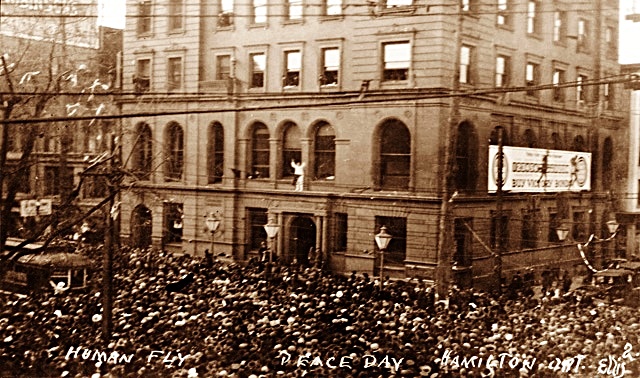
1918-11-09 HumanFly


“Barney Bergen, business manager for Harry H. Gardiner, the Human Fly, arrived in the city this morning and is busy today completing arrangements for Mr. Gardiner to climb the bank of Hamilton building at 12:30 o’clock Monday afternoon next.”1

1 Hamilton Herald.    November 09, 1918.

The strategy of the leaders of the Victory Loan campaign, in getting as many Hamiltonians as possible to subscribe, was to gather as many people as possible in one place. When that happened, Victory Loan could meet and hopefully convince as many citizens as possible to loan money to the federal government, with the commitment of the government to later repay those moneys with a handsome return.

To that end, it was decided to bring to Hamilton, Mr. Harry Gardiner, better known internationally as The Human Fly. Two days in advance of the Human Fly’s arrival in Hamilton, his manager arrived and made the rounds of the local newspaper offices for promotion purposes.

The Hamilton Herald carried the following account of the meeting with the Human Fly’s manager :

“In conversation with a Herald reporter, Mr. Bergen said Mr. Gardiner, during the past thirteen years, had successfully climbed seven hundred high buildings, throughout Europe and the United States. He commenced his ‘Human Fly’ act thirteen years by climbing the Flat Iron building in New York. With one exception, he has never had an accident. This was while climbing a building in the southern States, when he had a fall which laid him up for a few years.”1

1 “The Human Fly”

Hamilton Herald.    November 09, 1918.

The appearance of the Human Fly at the site of the Bank of Hamilton, King and James streets, had already been firmly scheduled for 12:30 p.m., November 11, 1918, before it was known that the date selected would be the one when it was confirmed that an armistice to end the Great War had been signed.

Wild celebrations had been underway since way before dawn on Monday, November 11, 1918. Also Hamilton Mayor Booker had declared the day to be a public holiday. For the Victory Loan people, it was a stroke of good fortune as the number of people capable of being present to witness the stunt of climbing the Bank of Hamilton building.

The Spectator published on November 12, 1918, carried the following vivid account of how the Human Fly carried off his stunt :

 “The most sensational stunt in connection with the Victory loan campaign, and one of the most nerve-wracking free exhibitions ever given in this city, was given by Harry Gardiner, the American Human Fly, at noon yesterday, on the walls of the Bank of Hamilton, in the presence of thousands of spectators. Mr. Gardiner climbed the wall from bottom to top, and when he reached the cornice, he swung out from the building supported by one hand only. He finally pulled himself on to the roof and disappeared from view. His daring act was freely applauded by thousands, although many held their breath at times. One woman in the gathering fainted and required medical attention.

“On his way up the wall, Gardiner addressed the crowd on Victory bonds, urging his hearers to do their utmost for the boys who fought for the world’s freedom. Bond salesmen passed through the crowd, and not a few persons subscribed.

“In an interview, Gardiner stated that his performance was not all due to strength in his hands and arms. ‘It is 60 % physical, and 40% mental,’ said the Human Fly, who has scaled the walls of over 400 of the highest buildings in the United States. The only fall he ever had was from the state capitol building of Carolina when, on a slippery day, he fell 51 feet, sustaining broken ribs and a smashed nose from which he carries the scar yet. Two months later, he made the climb where he fell.

“Gardiner’s home is in Washington. He left the city in the afternoon.”2

2 “Held Their Breath : While Human Fly Climbed the Bank of Hamilton Walls”

Hamilton Spectator.    November 12, 1918.


Thursday, 7 June 2018

1918-11-07 Spectator War End News Part 1


 “Hamilton learned through the Spectator that the war was over.

At twenty-five minutes past the noon hour, there appeared in the Spectator window a bulletin paper bearing the hasty scrawl :

‘The war is over – Hostilities cease at 2 o’clock today – Official’ ”

Hamilton Spectator. November 7, 1918.

The first floor windows facing the James street south side of the Hamilton Spectator were always the focus of interest  for people as they passed by. Bulletins received by telegraph, if considered to be of immediate interest would be pasted in that location.

During the lunch hour of November 7, 1918, a different kind of bulletin was pasted in the Spectator window, and the news being bulletined was extremely welcome:

“The greatest and most glorious news that Hamilton ever heard hit the city like a thunderbolt. The usual knot of bulletin readers perusing the morning war dispatches rubbed their eyes. They believed not for joy.

“Then a young girl gasped : ‘O-o-o-h! The war’s over!’ Somebody started to cheer, but the majority took flight to the nearest telephone to spread the joyful news.

“The glad intelligence spread like wildfire. Five minutes after the bulletin appeared in the window it was in everybody’s mouth in the streets. So the great war was over; the allies had won; the Hun vanquished at last. Glory Hallelujah!

“But it was not till about 1 o’clock that news had thoroughly filled the city. Then Hamilton abandoned itself in a delirium of joy. The celebration was of necessity of a spasmodic character. Sirens screamed, bells clanged, klaxons tooted, cheers resounded through the city streets.

“The telephone system was unprepared for the shock, and was disorganized automatically. Thousands and thousands of calls were put into central and central collapsed. By 1:15, there was not a chance of getting a number.

“Organization is being completed for a grand thanksgiving celebration to be held later.”1

1 “Spec Broke ‘News’ ”

Hamilton Spectator.    November 11, 1918.

The Spectator immediately assigned staff to cover the celebrations touched off by the news that the war was over.

The next day’s Spectator contained the following description of what happened:

“Did Hamilton celebrate that report?

“Yes, verily, she did – with a roar and a whoop that surely must have soared right past our own boys in France and Flanders and rattled the windows at Potsdam. The old town just turned itself inside out in frantic, spontaneous joy. The lid was torn right off’n the city. No official holiday proclamation was necessary. Everybody, big and little, young and old, just hiked for uptown districts and added their full share to the raw and raucous bedlam of noise that shook the city from end to end.

“Hamilton never had another celebration like it – and won’t equal it again until the boys who are making victory possible come marching home.”2

2 “Bedlam of Noise Shook Old Town From End to End : Peace Report Frantically Received By People : Was Wildest Time Hamilton Ever Experienced : Uptown Streets Choked With Cheering Throngs.”

Hamilton Spectator.  November 8, 1918.

It did not take long after the bulletin had been pasted in the window for things to get very raucous in the downtown core:

“It was just ten minutes after the report that had been signed had been bulletined in the Spectator window that the first parade was in action. Headed by a hatless man, who toted one of the biggest Union Jacks in town, the clerks of one of the uptown stores formed in line. Holding up the folds of the big Union Jack was an old women, who with tears of gladness streaming down her cheeks, fervently pressed the flag to her lips and kissed it time and time again..

“ ‘I bet she has a dear boy overseas,’ remarked a bystander.”2

Indeed, the reaction of the old woman would not be the only tearful one :

“There were hundreds like her, whose emotion had its outlet in tears. Not all of them had boys coming back, either. Many there were who, though thanking God that the titanic struggle of right against might was reported over, thought also of their own dear sweet men – sons, brothers, husbands, sweethearts – who sleep in Flanders fields where poppies blow – those heroes who so freely gave their todays that we might have our tomorrows. In hundreds of home yesterday afternoon and forbade an active part in the uptown celebration. The scars from the searing hand of the war god, Mars, were appallingly numerous.” 2

Those involved in the downtown scenes of jubilation put aside any feelings of sadness over those lost in the war for the moment. The news that the guns of war were silenced was all that they wanted to consider, and they wanted to parade:

“That first little parade took on numbers with every step. The postmen, armed with flags, fell in line. Every automobile was decked with flags and streamers and freighted down with noisy, frenzied humans, horns, tin pans, kettle covers that were pressed into service as cymbals. Tubs that were utilized as drums and – well, if you weren’t in it, you were strictly out of it.

“Where all the flags and noise-making instruments came from on such short notice will always be a mystery. One didn’t think there were so many flags in the world as were on display an hour after the celebration started. First of the local bands to put in an appearance was the crack musical organization of the 91st Highlanders, which, at 3 o’clock, rendered patriotic airs at the Gore, while thousands, quivering and shaking with excitement, cheered and sang themselves into hoarseness.”2

(To Be Continued)